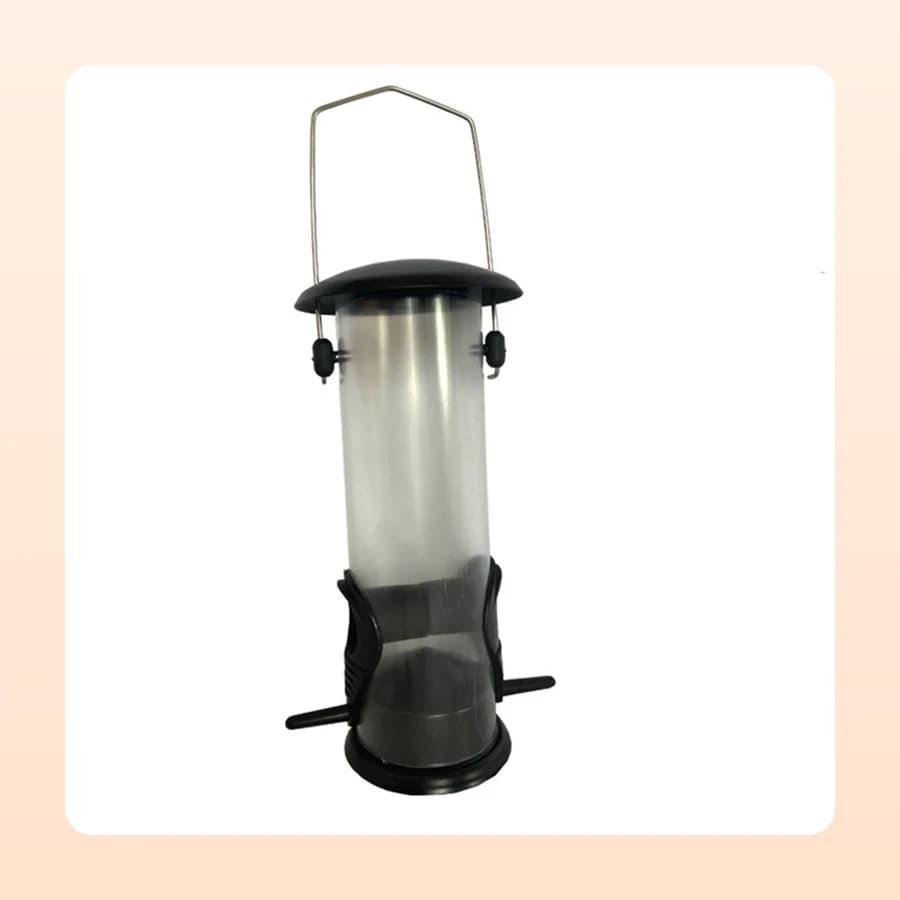
The seed stays in the hopper until the bird takes it.
Seed drops into the feeding tray only as the bird empties it, so the exposed area stays shallow and husks are easier to see and clear than in a deep full dish.
£11.99
Taxes calculated at checkout
Clear body, so the level is readable without opening the cage
Hooded tray keeps flicked husk inside the feeder
11.2 x 8.4 cm footprint, 18.1 cm tall domed or 17.2 cm pitched
Hangs on standard cage bars
White, green or yellow
Roof: Domed
Height: Standard
Colour: White
1
Free shipping over £45
Free 30 day returns
Secure checkout
Why you'll love it
Made for happy, healthy pets
It is gravity, not electronics
The listing calls this automatic. It is a hopper: seed falls when the tray empties, and that is the whole mechanism. There is no motor, timer or portion control, and nothing in it to fail.
The mess is the point
A budgie can throw husk a metre from an open dish. The hood and the raised lip mean most of it lands back in the tray, so the cage floor stays readable and you can see what has actually been eaten.
Do not treat it as cover for being away
The supplier's photography promises a week unattended. Do not do that. Seed bridges above the outlet, water still needs changing daily, and a bird with a jammed hopper has no food at all.
Good fit if
Reducing how quickly a feeding area fills with husk
Holding several days of seed without a deep exposed dish
Cages where you cannot check the food every morning
Aviaries feeding several birds from one point
Look elsewhere if
You feed mostly fresh food, which will not flow
You want an enclosed feeder that contains husks
You would rather see the whole ration at a glance
Shallow beats deep
A deep dish filled to the top is where the husk problem hides. The bird eats from the surface and drops shells back, and within a day there is a layer of husk sitting on seed you cannot see. It looks full, and the bird may be working harder for each mouthful than you realise.
A hopper keeps only a shallow layer exposed. Husks sit on a thin bed rather than accumulating over a deep reserve, so a puff of breath clears them and you can see the seed underneath immediately. The reserve above stays sealed and clean until it is needed.
Flow and clogging
Two things stop a hopper flowing. Bridging is the first, where seed arches across the opening and holds itself up so nothing falls through even with a full reserve. Larger, irregular mixes bridge more readily than small round seed.
Moisture is the second, making seed tacky enough to clump against the walls. Both look identical from outside: a full hopper over an empty tray. Check the tray rather than the reserve when you do the morning round, because that is where the problem shows.
What it does not solve
It reduces the depth of husk in the tray. It does not stop the bird flicking husks out of the cage, because the feeding position is still open. If floor mess is the problem you are trying to solve, an enclosed feed box and a cage skirt are the tools for that.
It also does not change the diet. Seed alone leaves most companion birds short of vitamin A and calcium, so a hopper handles the dry staple while fresh vegetables, a calcium source and, for many species, a formulated pellet still need offering separately.
In an aviary the calculation shifts slightly, because a hopper holding several days of seed reduces how often you disturb the flight. Even so, more than one feeding point is worth having, since a single station in a group of birds becomes something the dominant individuals stand over.
In the box
Everything you need
1 seed hopper with cage hanger
How it works
Simple, from basket to doorstep
1
Browse
Shop by pet or category to find exactly what your cat or dog needs, no wading through thousands of listings.
2
Order
Check out securely with card, PayPal or one tap Apple Pay & Google Pay. Free delivery over £45.
3
Delivered
Fast, tracked dispatch straight to your door, and a happier pet before you know it.
The details
Specifications
Footprint
11.2 x 8.4 cm
Height
18.1 cm domed, 17.2 cm pitched
Shipping box
13 x 10 x 22 cm, 1.05 kg
Material
Plastic body, clear acrylic front
Fitting
Hangs on standard cage bars
Emptying and washing
Empty the whole thing weekly rather than topping it up indefinitely. Seed at the bottom of a reserve that is never emptied goes stale, loses vitamin content and in a humid room can grow mould, and continually adding fresh on top keeps that layer permanently in place.
Wash with hot water and a brush that reaches the reserve, then dry it completely before refilling. Damp is the main cause of clogging, so a hopper refilled while still wet inside will bridge within days and you will be looking for a fault that is not there.
Loved by real pet parents
4.5· 10 reviews
Pair of budgies
Husk lands back in the tray
The open dish meant a ring of husk around the cage every morning and now most of it stays under the hood. I can also see what has actually been eaten rather than guessing under a layer of hulls. I went for the domed roof in white.
Janet R.· United States· 19 September 2025
Cockatiel
Seed bridged over the outlet once
I caught it in the third week when the tray looked full but the level in the body had not moved, and a tap on the side sorted it. Worth knowing if you were thinking of leaving it over a weekend, which I certainly would not now. Otherwise it holds a good few days and the clear front is genuinely useful.
Colin V.· United Kingdom· 2 March 2026
Hangs flat against the bars
It hooks straight onto standard cage bars and sits flush rather than swinging when she lands on the tray. The 11.2 by 8.4 footprint takes up far less of the cage side than the dish holder it replaced. Mine is the yellow one and it has not faded at all.
Shazia M.· Germany· 27 June 2026
Lovebird pair
Pitched roof cleared the cage top
I measured the gap under the cage roof and the 17.2 cm pitched version fitted with a centimetre to spare where the domed one would not have. The clear front means I can read the level without opening the door in the morning. Simple bit of kit that does what it says.
Rory T.· Austria· 26 November 2025
Not automatic in any real sense
I will admit I saw the word automatic and expected more than a box that lets seed fall when the tray empties. That is all it is, and to be fair the description says so plainly. It keeps the mess down and I do use it, I just went in expecting something it is not.
Pauline H.· Germany· 20 January 2026
Green cheek conure
The hood does most of the work
He still flicks seed about with real enthusiasm but the hood and the raised lip send nearly all of it back into the tray. The cage floor is readable now, which is how I spot anything out of the ordinary. Green one, hangs on the bars, no rattling.
Isaac B.· United States· 11 August 2026
Budgie and cockatiel
Tray is fiddly to get right out
Cleaning it properly means working the tray out from under the hood and mine is a tight fit, so it takes both hands and a bit of care. Once it is out it rinses in seconds. Two birds get through a fill in about four days and I can see exactly where it is up to.
Tracy N.· Italy· 31 July 2025
Filling it twice a week now
It holds enough that I am filling it twice a week instead of daily, but I still change the water every morning and glance at the seed level while I am there. The clear body makes that a two second job. Domed roof in white to match the cage.
Kieran O.· Sweden· 1 May 2026
Aviary budgies
Tall version was the right choice
I went for the tall option because the cage has the height for it and it means fewer refills without a wider footprint. It hangs solidly on standard bars with no sag at all. The hooded tray keeps almost all the husk inside, where the old dish spread it across the room.
Marguerite P.· United States· 15 April 2026
Loading
Good questions
Before you buy
No. The supplier's title and every one of its photographs say automatic; it is a gravity hopper with no moving parts. Seed drops as the tray empties, and that is all it does.
A few days for one budgie, less for a pair or a cockatiel. Check it daily, as seed can bridge above the outlet and leave a full looking hopper feeding nothing.
The tall version holds more but needs about 21 cm of clear bar. Measure between your perches first; a hopper that fouls a perch gets knocked off within a week.
It is not sealed for it. Use a proper drinker, because water in an open hopper tray fouls within hours.
Look at the tray, not the reserve. A clogged hopper looks identical to a working one from outside, and an empty tray under a full hopper is the only reliable sign.
Only a little. It keeps the tray shallower but the feeding position is still open, so husks are still flicked out. An enclosed feed box plus a cage skirt is what cuts floor mess.
Fill it, note how far the level drops in a day, and work from that. Regardless of capacity, empty and refill weekly so the bottom of the reserve never goes stale.
Most pet birds are fed a diet that shortens their lives, and it's the one sold in every pet shop. Here's what to feed instead, and how to make the switch.