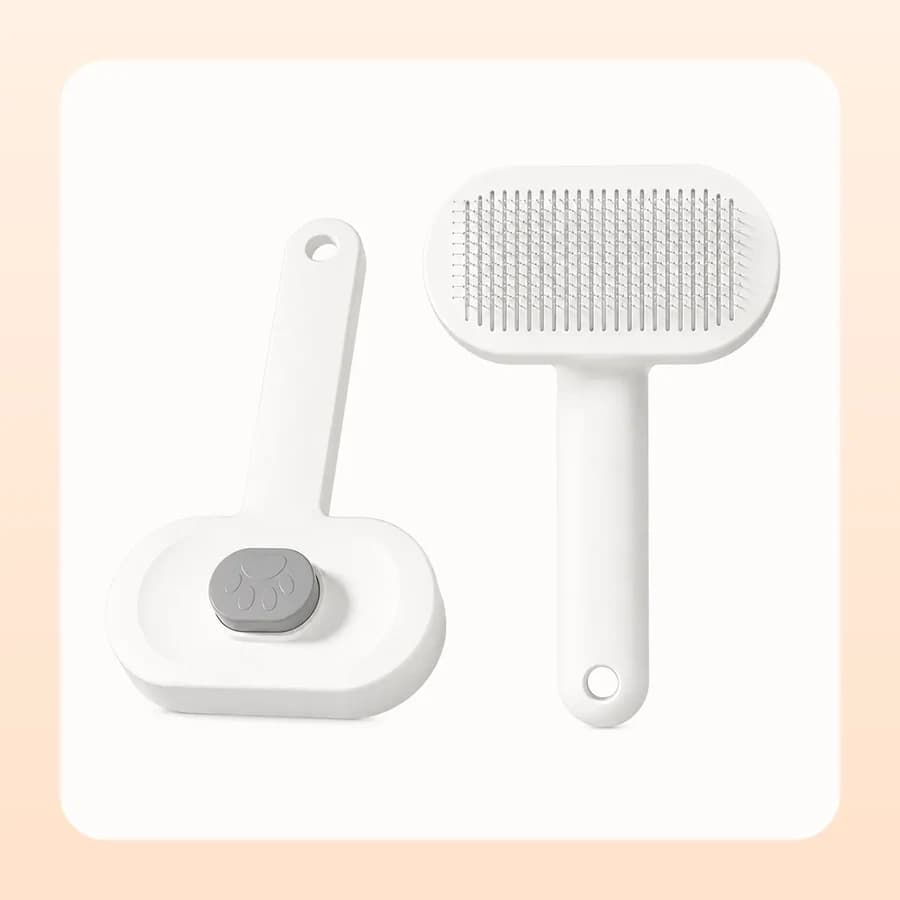
The cat does the grooming and you do nothing. For a cat that fights a brush, taking yourself out of the interaction entirely is often the only approach that works.
£16.99
Taxes calculated at checkout
Soft TPR spikes that massage rather than scratch
Hollow body takes catnip to draw them over
Fits internal and external wall corners
No mark adhesive, no screws
Works while you are out of the house
Colour: Blue
1
Free shipping over £45
Free 30 day returns
Secure checkout
Why you'll love it
Made for happy, healthy pets
Grooming with no handling
Cats that refuse a brush will happily rub their own face against something. This collects the same loose fur without a wrestling match.
Cheek rubbing is scent marking
The cheeks are where cats deposit calming facial pheromone. A dedicated rubbing post gives them somewhere to do it that is not your furniture.
Less fur on everything
Fur caught here is fur not on your sofa. It is a small daily reduction that adds up through moulting season.
Good fit if
Cats that will not tolerate being brushed at all
Moulting season, when loose fur is everywhere
Working households where nobody is home to groom
Giving a cat a scent marking spot of its own
Look elsewhere if
Your cat has matted fur, which needs hands and a comb
You have no suitable corner or table leg at cat height
You rent and cannot risk adhesive on the wall finish
Removing yourself from the equation
A cat that objects to brushing is usually objecting to being held and to something being done to it, rather than to the sensation itself. That distinction matters, because the same cat will rub its face and flanks enthusiastically against a door frame given the chance.
A fixed groomer works with that. The cat approaches when it wants, rubs as hard as it likes, and stops when it chooses. Loose fur comes out the same way it would with a brush, but nothing is being done to the cat, so there is nothing to resist. Cats that have never accepted grooming will often use one within a day.
Cheek rubbing is scent marking
The rubbing this invites is not only about fur. Cats have scent glands on the cheeks and around the mouth, and rubbing deposits scent on things they consider part of their territory. A fixed object at head height is close to an ideal target for that.
That is why these get adopted so readily, and why they can help a cat settle into a new home or a changed room. The catnip compartment accelerates it further, though roughly a third of cats have no catnip response at all and will use the groomer perfectly happily without it.
Where to fit it
Corners work best because a cat can get both cheeks and a flank against the surface in one pass, which is why cats target door frames and wall corners naturally. An external corner suits a cat that rubs while walking past; an internal corner suits one that stops and works at it.
Put it on a route the cat already uses rather than somewhere convenient for you. Beside a feeding spot, on the way to a favourite window, or at the entrance to a room it passes through constantly. A groomer in an unused corner of a spare room will not be found.
In the box
Everything you need
Corner self groomer
No mark adhesive pads
How it works
Simple, from basket to doorstep
1
Browse
Shop by pet or category to find exactly what your cat or dog needs, no wading through thousands of listings.
2
Order
Check out securely with card, PayPal or one tap Apple Pay & Google Pay. Free delivery over £45.
3
Delivered
Fast, tracked dispatch straight to your door, and a happier pet before you know it.
The details
Specifications
Material
Soft TPR
Fitting
Adhesive, corners or flat
Extras
Hollow catnip compartment
Care
Rinse under the tap
Best for
Brush averse cats and moulting
Cleaning and adhesive
Pull the collected fur off every few days and rinse the spikes under a tap when they start to look greasy. Skin oils build up on TPR and reduce how well it grips loose hair, so a rinse restores it. Let it dry before refitting if you have taken it off the wall.
The adhesive holds best on clean, smooth, dry paint. Wipe the wall with a little rubbing alcohol before fitting and leave it an hour before letting the cat at it. To remove, warm the pad with a hairdryer and peel slowly rather than pulling, which is far kinder to the paint underneath.
Loved by real pet parents
4.5· 19 reviews
Two indoor cats
Stuck it on and walked away
I put a pinch of catnip in the hollow part and she found it within the hour. Now she does a lap of the hallway and rubs both cheeks against it every time she passes. I have done nothing since.
Rebecca I.· Australia· 16 May 2026
The adhesive needed a warm room
It went up on a cold external corner in the porch and dropped off twice in a week. Moved inside onto a skirting corner it has held for months with no mark on the paint. The spikes are soft enough that she leans her whole face into it.
Hugo F.· United Kingdom· 13 November 2025
Senior tabby
The brush hater finally grooms
She has never let a brush near her and I had given up trying. She does her own flanks against this and there is a proper drift of fur underneath it by the end of the week, which is fur not on the bed.
Delyth J.· Canada· 19 February 2026
Bengal
Catnip compartment is the trick
Without catnip in it he ignored the thing for two days. With it he was on it immediately and now he uses it out of habit even though the catnip faded weeks ago.
Karl S.· Denmark· 11 August 2025
Two rescue cats
One cat loves it, one ignores it
The tabby uses it constantly and there is always fur in the spikes. The other one has looked at it once in two months, so for us it is half as useful as I hoped. No fault of the thing itself, cats are just like that.
Nora T.· Australia· 27 June 2026
Fits the corner properly
It wraps around an external corner rather than sitting flat against one wall, so he gets both sides of his face in a single pass. The soft spikes flex instead of scratching, which is why he bothers with it.
Tobias W.· United Kingdom· 2 March 2026
Long coated cat
Clean it more often than you think
Loose fur builds up in the spikes quickly and once it does she stops using it. It rinses out under the tap in about ten seconds, I just have to remember to do it every few days.
Meg H.· Netherlands· 27 October 2025
Nervous rescue cat
Works while we are at work
The appeal was that the grooming happens without me involved at all. We come home to fur caught in the spikes and a cat who has been perfectly content on her own all day.
Edward A.· United States· 22 August 2026
Less fur on the sofa
Moulting season is usually unbearable here and this has taken the edge off it. The only thing I would change is the height it sits at, she has to crouch slightly to get her flanks onto it.
Suzanne D.· Australia· 15 January 2026
Loading
Good questions
Before you buy
At cat head height on a corner they already walk past. Somewhere they pass every day beats a perfect spot in a room they ignore.
It is designed to peel away cleanly, but test a small area first on fresh paint or delicate wallpaper.
On a corner the cat already walks past, at standing head height so it can rub without stretching. A route it uses daily works far better than a spot that suits you.
On sound paint it usually comes away cleanly if you warm the pad first and peel slowly. On textured wallpaper or a chalky finish it can lift the surface, so test somewhere hidden.
For a short coated cat during a moult, often yes. A long coated cat still needs hands and a comb for matting, which no self groomer will resolve.